Introduction
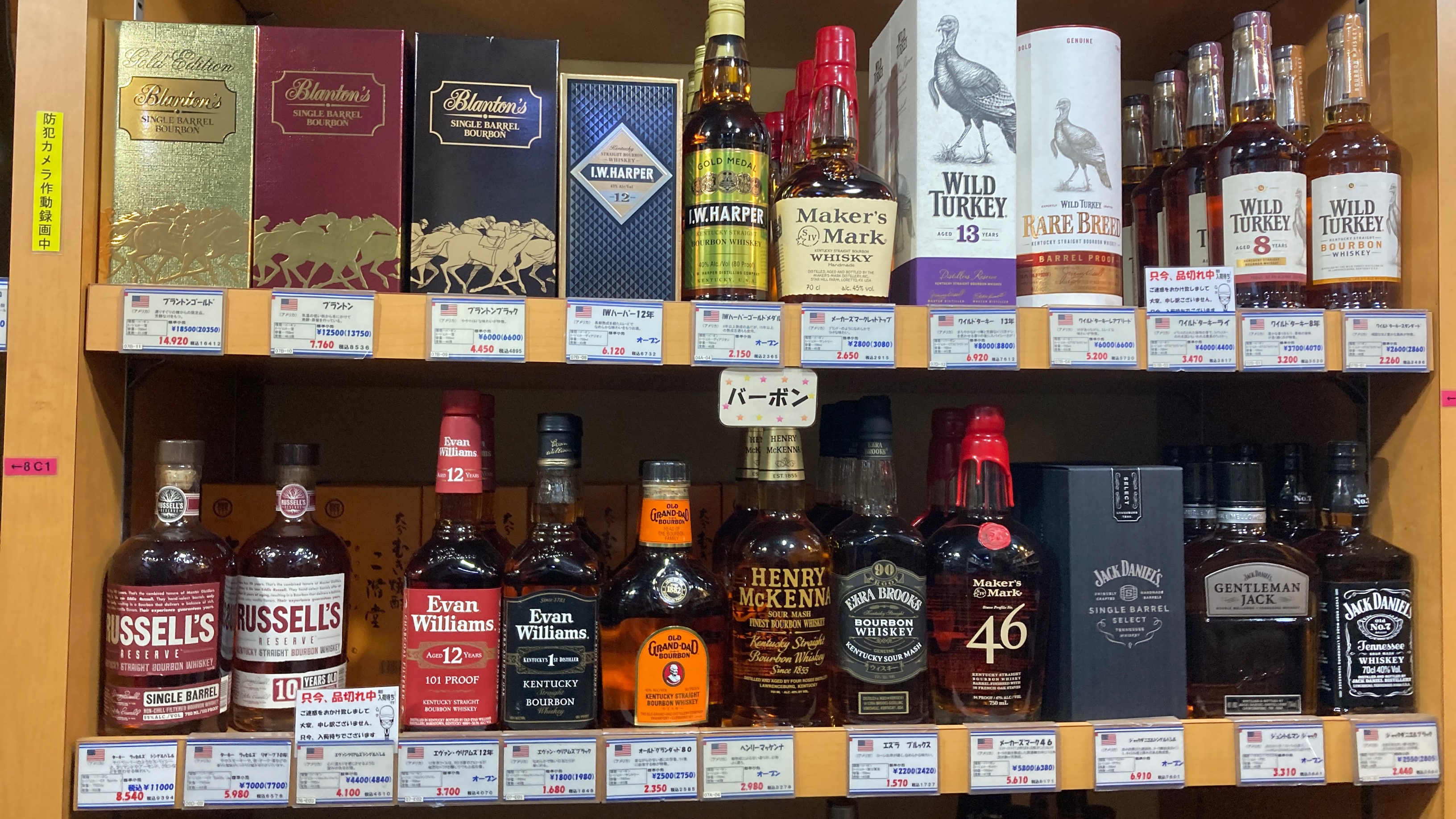
Let’s start this off by saying that I live in Japan. I got into bourbon while I was in Japan. And all I know are the bottles I see on shelves, here in Japan. If you wanna get nitpicky, I’m also talking bottles I see here in my little nook of Sapporo, Hokkaido, Japan.
With that out of the way, let’s address the elephant in the room shall we. Bourbon. Prices. WTF is going on with this? Seriously.
The first time I realized what kind of crazy bourbon world we’re living in was when I spotted a bottle (or two) of Blanton’s Black at an everyday shop being sold at MSRP, and thought ‘Hey! I know that. That was that one bottle my friend got me when he visited. Said there’s mad hype around this.’ and then briefly checking how much this is being sold in the US for…

Let’s just say my reaction to some of the prices I was seeing resulted in a flurry of expletives, mostly out of shock, confusion, and the sheer ridiculousness of it all.
Nonetheless, my interest was peaked, and it had my attention. Why is the pricing so different over here in Japan versus what it would be in the US? Well, finding the answer to that led me down a deep rabbit hole, starting with learning about the origins of how bourbon came to Japan and rose in popularity.
A Brief History of Bourbon in Japan
Get your thinking bourbons out, cuz we’re about to get historical up in this piece. (Note: emphasis on brief)

So, it’s been said that after World War II, American soldiers brought bourbon with them to Japan, and the locals quickly fell in love with it. But it wasn’t until the 80s, during the economic boom, that bourbon really took off in Japan. People were getting rich, and they wanted to spend their cash on fancy stuff, luxury goods and experiences. That’s where bourbon came in.
One of the earliest Japanese companies to import and distribute bourbon was Suntory, which started selling Jim Beam in Japan in the 1950s. Suntory also established a partnership with Beam Suntory, the American company that owns Jim Beam. They even made a special version of Jim Beam just for the Japanese market called “Jim Beam Black Label 8 Year.” It was like regular Jim Beam, but with a Japanese twist.
As bourbon’s popularity grew in Japan, so did the demand for premium and high-end brands. Japanese consumers were willing to pay top dollar for rare and limited edition bourbons, leading to increased exports from American distilleries to Japan. This trend was also fueled by the rise of the Japanese whisky industry, which led to a growing interest in all types of whiskey, including bourbon.

In recent years, the popularity of bourbon in Japan has continued to grow, with Japanese consumers showing a preference for small-batch and craft bourbons. Some American distilleries have responded to this demand by producing bourbons specifically for the Japanese market, such as the “Blanton’s Takara Black/Red/Gold“, “Four Roses Super Premium”, or “Evan Williams 12 Year” releases.
Today, Japanese consumers are among the most avid fans of bourbon, and the demand for premium and limited-edition bourbons continues to increase.
Factors Affecting Bourbon Pricing in Japan

Like with any market, and Japan is no different, when it comes to the pricing we’re seeing for bourbon, there are a few basic things that can come into play.
For starters, how much of the juice whiskey is available versus how many people want it can (and will) affect the price. And if a bourbon is rare or limited edition, you can expect to pay more for it because everyone wants what they can’t have. Basic supply and demand, folks. Supply. And. DEMAND. This isn’t unique to Japan, but still a very important point to note and emphasize.
Next on the list are taxes, woohoo! Taxes are also a big factor. Japan has some pretty high import duties on booze, which can make bourbon more expensive here than in other countries. And, of course, the way the bourbon gets to Japan can affect the price too. Shipping and storing it all costs money, and those costs can be passed on to the consumer.
Lastly, how the bourbon is marketed can make a difference. If a distillery positions its bourbon as a high-end or luxury product, you can expect to pay more for it. On the other hand, some distilleries may want to appeal to a wider audience and offer more affordable options.
So, whether you’re a bourbon producer or a consumer in Japan, it’s important to consider these factors when it comes to pricing. And if you’re a bourbon lover, just remember that sometimes you have to pay a little extra for something special.
My Personal Experience with Bourbon Pricing in Japan
One of the biggest surprises I encountered when I first started exploring the world of bourbon in Japan was how close the prices were to MSRP. Unlike in the US, where prices can be highly variable depending on availability and demand, in most cases, prices in Japan will be at or close to MSRP.
On the surface, it seems that most shops will largely stick to the MSRP and adjust if/when there’s a shift in exchange rate, which I’ve observed to be the case. In recent days (we’re talking pandemic era days), the USD has been quite strong against the JPY. So for someone like me living in Japan, that’s not great news in terms of pricing, which I’ve been seeing going up and up. And that’s only within the span of two years. But even with that, there are still some bottles here, particularly ones meant to be exported to Japan (or ones that might be allocated in the US), that will forever have prices that are much lower than what you’ll see in the US.
In any case, the pricing of bourbon here is fair to say the least, and this has made it easier for me to budget and plan my bourbon purchases, and has allowed me to try a wider range of bourbons than I might not have been able to if I were in the US. Mind you, the selection in my area while decent, pales in comparison to the selection in the US. Naturally, so. While folks in the US are pining for the kind of availability and prices we’re seeing for some particular bottles here in Japan, I’m very much doing the same for “every day” bottles available in the US (e.g. Old Forester 1910/1920).
In this section, I’ll be sharing my personal experiences with bourbon pricing in Japan, and highlighting some of the benefits and challenges of this pricing model. From affordable options to rare and limited edition bottles, I’ll discuss how these pricing differences have influenced my bourbon journey in Japan.
Evan Williams 12 Year

- Brand: Evan Williams 12yrs
- Price: ¥3700 / $32 (March, 2022) → ¥4580 / $34 (May, 2023)
- Location: Sapporo
I think it’s only appropriate that I start out by mentioning one of the most affordable value bourbons I came across and picked up early on in my journey, and that was Evan Williams 12 Year Old Kentucky Straight Bourbon Whiskey. I remember stumbling across a bottle of Evan Williams 12 year old bourbon at not just one, but several, liquor stores in Sapporo. I learned that this particular bottle was only available for export to Japan, but then later become available to purchase at the distillery.
Considering how available it is here at around a consistent ¥4000JPY range ($29USD), I was quite shocked to discover that what it’s being sold for at its own distillery is over x4 times more at $130. Online shops like Cask Cartel and Frootbat are selling this bottle at $259.99 and $235.99 respectively. That’s literally more than double the distillery’s pricing!
Old Ezra 7 Year

- Brand: Old Ezra 7
- Price: ¥5480 / $41
- Location: Sapporo
Old Ezra 7 Year Barrel Strength is something I wish I had tried much sooner. Despite regularly seeing it on shelves, it did take me while before finally getting around to it, but when I did, man oh man… I already knew this was going to be a new daily. My review of this particular bottle is a post for another time, but for now, let’s continue to talk pricing.
For a 7yr age-stated barrel proof pour, I would argue that this bottle is absolutely worth picking up when priced at MSRP. The price on this one when I grabbed it was at around $41USD (per today’s current exchange rate). This number has not budged, even after a year when I first became aware of it and seeing it in several shops.
Word on the street pricing for this bottle in the US is floating around the $60, $70, $80-ish range based on what I’ve read up on. Meanwhile, checking up online, I’m seeing $96.99 on Drizly, $104.99 on Frootbat, $149.99 on Cask Cartel, $61.99-$102.99 on Caskers (depending on state).
Blanton’s Gold (intl. version, 700ml)


- Brand: Blanton’s Gold
- Price: ¥14,500 / $132 (then), ¥23,980 / $177 (now)
- Location: Sapporo
Blanton’s Gold was the first premium-priced bourbon I discovered and purchased (with Blanton’s Takara Red coming in second). I know what you all are thinking, but before casting your judgments and start throwing potatoes at me, if you’ve never had it and it’s in your store at close to MSRP, what would you do? You just think about that for a bit.
Mind you, still quite uneducated and unaware at the time, it wasn’t until later on that I realized that 1) Blanton’s Gold was more available in my area than I thought, and 2) there is the Blanton’s Takara Gold version, the bottle made and distributed just for the Japanese market. Not only did I find the latter to be 50ml more than the 700ml international version, but it’s also said to be aged two years longer and it comes in a proper shiny gold box, which cost nearly the same. I was so confused. If I had known all of this from the start, I would have ditched the international version altogether.
*sigh*… live and learn. Moving on.
The price of the bottle I picked up was ¥14,500 ($132) at the time. Fast forward to 2023, a little over a year later, and I see the price now at nearly double at ¥23,980 ($177). This had me genuinely surprised (but also not really). While most prices on bottles have indeed risen a bit, Blanton’s Gold is the only bottle I’ve seen on shelves that has had this dramatic of an increase. However, when circling back to comparing it to the pricing and availability that’s seen in the US, it’s still probably a relatively better deal in Japan. Whether you think the price tag is still worth it will be for you to determine.
On Wine-Searcher, out of 61 results, the average price Blanton’s Gold is being sold for is approximately $163.54 USD. $249.99 on Frootbat. $228.99 on Caskers.
If you’re digging what you’re reading, enter your email then hit that subscribe button, my friend!
You’ll never miss a post and can stay in the loop with everything bourbon in Japan.
At the end of the day, you might be wondering how have these pricing differences influenced my bourbon journey and exploration in Japan? How have these differences affected which bourbons I choose to buy or try?
My experiences with bourbon pricing in Japan have shown me that in most cases, prices will be at or close to MSRP. While exchange rate fluctuations have caused some price increases, the pricing I’ve seen here is mostly fair. The level of price gougery I hear about that goes on in the US for some bottles is not something I’ve seen or experienced here in Japan, at least with bourbon, and I think there are a few main reasons for that.
One of the most notable differences between the US and Japanese markets is the level of demand. While bourbon has always been a popular drink in the US, it has only recently gained a significant following in Japan, with many Japanese consumers developing a strong appreciation for the spirit. In the US, this increased demand has led to a surge in prices for some bottles, particularly for limited edition or highly sought-after releases.
However, in Japan, despite everyone’s newfound enthusiasm for bourbon, bottles that could be considered no-brainer buys (or highly sought-after) may remain on shelves for some time if they’re not too well known or there isn’t any information provided in Japanese. This is one of my main theories why some bottles may go untouched. Japanese people are generally risk adverse and the English level is quite low, so combine those factors with imported whiskey that has no information about the bottle besides its ingredients, then naturally we may see slower sales on those bottles. Something I’ve observed store owners do, as an effort to promote the bottles they have, is that they’ll usually include a brief Japanese description (sometimes even hand written!) of the bourbon next to the price tag. This is likely because they know that if there’s no description otherwise, customers won’t even bother.

Another difference is the regulatory environment. In the US, bourbon is subject to a complex set of federal and state regulations that can vary from state to state. This can result in different pricing for the same bottle of bourbon depending on where it is sold. In Japan, there are also regulations in place, but they are generally less complex and more consistent across the country.
The role of distribution is also different between the two markets. In the US, bourbon is typically distributed through a three-tier system, with distillers selling to wholesalers, who in turn sell to retailers. This can add to the cost of the final product. In Japan, however, there is a more direct relationship between the distiller and the retailer, which can result in lower prices.
Finally, exchange rates can also play a role in pricing differences. Fluctuations in exchange rates between the Japanese yen and the US dollar can impact the cost of importing bourbon into Japan and can affect the price that consumers pay for the product.
Japan’s pricing “model”, if you will, has allowed me to budget and try a wider range of bourbons than I might have been able to in the US, and discover new and unexpected bourbons. And for me, some of those bottles are what some may consider everyday finds in the US. For example, you would not believe how ecstatic I was when I first discovered that one of my local stores was carrying Michter’s US1 American Whiskey. Yes, the entry-level lowest proof offering from Michter’s. This is not usually available here, and so in my mind, it was like finding a unicorn.
The US still has it way better in terms of selection and variety. However, for very specific bottles, like export-only, traveler exclusives, or *cough* Blanton’s *cough cough* (excuse me), Japanese liquor stores will be ripe for the picking, and you can expect prices to be relatively reasonable. So if you ever make a visit to the country, be sure to take advantage of what’s available here.
Tips for Navigating Bourbon Pricing in Japan
If you’re a bourbon enthusiast looking to explore the Japanese market, there are a few tips and tricks that can help you find good deals and navigate the market with ease.
Firstly, research is key. Before you even set foot in Japan, make sure to do your homework on what bourbons are available and where to find them. There are many online resources available, such as bourbon review sites and online marketplaces, that can help you get a sense of what to look for and what prices to expect. Search Rakuten or Amazon Japan (yes, I’m serious about Amazon) for bottles you want. Order them even! Expect prices to be slightly higher than what you may find in-store, but you’re basically paying for convenience, and the difference can be negligible. Also, if what you’re looking for is available enough to be found online, you can bet that it’ll be something you can also find in a store.

Secondly, be aware of the exchange rate. Fluctuations in the exchange rate between the Japanese yen and the US dollar can have a significant impact on pricing, so make sure to keep an eye on the exchange rate before making any purchases. If you’re coming from the US, your dollar will likely still be stronger against the yen, so that’s good news for you!
Thirdly, consider visiting smaller liquor stores. These stores may have a smaller selection than larger retailers, but they often have unique and hard-to-find bottles at reasonable prices. Stores that are located further out from a major subway or train line would also mean less foot traffic from the usual tourists, which means higher likelihood of untapped gems.
Finally, don’t be afraid to ask for advice or recommendations from local experts, such as bartenders or store owners. Obviously, some level of basic Japanese may be needed here, but there’s no greater source of insider info than that of the locals.
Conclusion
I hope my experience with bourbon pricing in Japan has been informative, and perhaps a little helpful, for you. It’s fascinating to see the differences in pricing and market dynamics between different regions. What are your thoughts and experiences with bourbon pricing in your region? Let’s chat in the comments!
Leave a Reply